My interest in tarot and witchy things started in my teens. It waxed and waned over the years for many reasons. When I found my way back to this passion, I wasn’t much further along than the teenage girl who dabbled in magic in the sense that I still didn’t know things like how to select a deck, what resources are trustworthy, and so on.
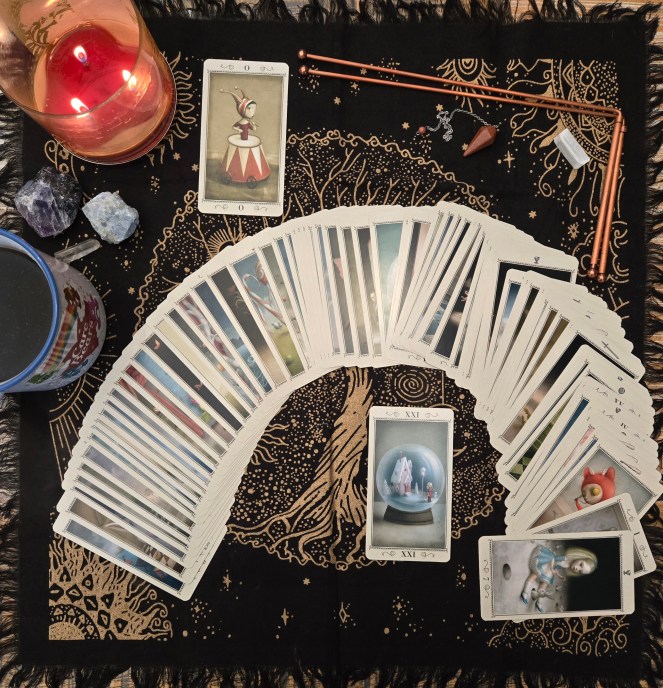
In 2023, I purchased a tarot reading from a Witch who worked in a store in the West Edmonton Mall. I spoke to her briefly about how to do a reading, then, armed with the knowledge that I needed to select a deck that “spoke to me,” I purchased a fantasy-themed deck created by Nicoletta Ceccoli. I was over the moon about the imagery and felt drawn to the Alice in Wonderland vibes it gave me. To this day, I love the deck. It is beautiful.
There was so much I didn’t know, like Tarot versus Oracle versus Lenormand (those differences are for another post). Most importantly, I didn’t know that a deck “speaking to me” wasn’t enough, at least for a learner. I couldn’t (still can’t) read with the beautiful deck I purchased, even though I reviewed each card and read the accompanying booklet over and over. I read other books on Tarot, took online classes, and used the deck for a year and a half for daily card draws. The deck and I just never connected.
As I submerged myself in the Tarot world and conversed with other readers, as well as mediums and psychics who do and don’t read cards, I learned it is okay to not connect with a deck. This isn’t a failure, and it doesn’t mean I can’t read Tarot. It only means that Deck and I can’t work together for divination. I didn’t know people collected Tarot and Oracle decks just to enjoy the artwork. I had it in my head (perhaps a myth) that if you owned a deck, it had to be a working deck. It doesn’t.
Since then, I have found two decks that I connect with, and our readings together have been successful for clients and me. So, here is what I would like you to know if you’re searching for a deck to read with:
- The deck will speak to you, meaning you will be drawn to it, perhaps without knowing why. It should feel inviting and not intimidating. You should feel excited to pick it up and practice.
- If you are a beginner, it is helpful to start with a deck that follows the Rider-Waite-Smith system. This system is widely used and has easy-to-find resources. It is easier to learn when you feel supported instead of confused.
- Fully illustrated and not a pip deck. It should have imagery that speaks to you. Clear symbolism is easier to learn than more abstract decks.
- Make sure the deck comes with a guidebook.
- Card size and quality are important. Depending on your hands and your reading space, the mini decks can be lovely to work with. I have a mini and a regular size I read with. I didn’t know quality was something to consider, and I have a couple of decks that are miserable to shuffle, which makes them challenging to use for a reading. For example, glossy finishes can be slippery, and flimsy cardstock bends and wears fast. In my experience, matte and linen finishes handle better over time and develop a nice feel as you use them.
- There is something satisfying about shuffling them.
- There are smaller things, like whether the deck uses Roman Numerals or Hindu-Arabic numerals (modern number notation), whether the deck is coloured or black, grey, and white, whether the major arcana cards are labeled or just numbered, and whether there are keywords on the card, and so on.
Here is what to remember: There is no wrong choice. The right deck is the one that makes you want to pick it up again. And chances are, your first deck will not be your only deck.


What a great intro post! I wish I’d read something similar when I was first starting my Tarot journey.
One lesson I’ve learned is that, depending on your intention with a deck, the imagery can be very important for your guides as well. For example, I tried using a deck with modern imagery for Ancestor work and hit a wall. However, once I purchased a deck with land based imagery, the communication came fast and clear. Tarot (and Oracle work) are, for me, such a collaborative effort 🙂 I love it so much!
LikeLiked by 1 person
I feel the same way, Melissa. I have a few decks that I wouldn’t have purchased if I had a bit more information going into it. And I agree completely about the imagery; it is a big part of how I connect and read Tarot and Oracle.
Do you do client readings? Maybe we could read for each other sometime.
LikeLike
I don’t read Tarot, but my husband has a lot of decks. 🙂 I think he likes collecting the decks more than reading the Tarot.
LikeLiked by 1 person
The artwork in some decks is so beautiful. So, I understand being a deck collector.
LikeLike
Very true!
LikeLike